As many of you may or may not be aware the State of Ohio recently changed the law so that a brewery can have a tasting room without having to get an additional license. Previously the state A-1 license allowed you to manufacture but not sell on premise. To sell on premise required the addition of an A-1-A license which cost an additional $3,906 annually. Along with that came several requirements which essentially made your business a brewpub (must serve hot food, etc.). This puts you in the restaurant business which is something most breweries don't want to deal with (board of health, etc.). The change in the law now allows breweries to serve their own beer on premise without having to pay the additional license fee or serve food. This is a great step forward for Ohio and puts us on par with many other states that "appreciate" craft beer. The breweries and micro-distilleries that lobbied for this change should be applauded because (as with anything in government) it wasn't easy to get this passed.
So now I often get asked "will you have a tasting room?" If people stop by to visit they ask "where will the tasting room be?" It's a legitimate question but the fact of the matter is I can't afford to do one right out of the gate. When I secured the lease on my space last year the law had not yet passed so it was not paramount on my list of "must haves" when I was looking at spaces. I wanted to be sure to get the basics that I needed to build a functioning brewery together before worrying about things that (at the time) may or may not happen. My brewery is one big open room and I will be using every square foot of it for production space. Plus there are a few new requirements that come with adding a taproom to a brewery in Ohio that make it not as easy as some may think.
The new law requires that you must have separate bathrooms for Men and Women and they must be ADA compliant (Americans with Disabilities Act) which is pretty complicated. You must also have a 3-vessel sink to wash glassware (or use disposable cups) or a commercial dishwasher. While these seem like simple and legitimate requests the fact is I only have 1 bathroom and no 3-vessel sink. So while the law removes the need to pay an additional $3,906 license to serve on premise it DOESN'T come with a $10,000 check so that I can become compliant with the requirements set forth in the law.
Again, I am not complaining that these requirements are out of line just that I am not in a position to meet them right now. I'm self-financed and since everything is coming down to the wire financially as I approach opening (all I ate today was a Snickers Bar to save money) the fact is that these are not expenses that I could incur even if the law was already in effect years ago.
There is also another "hidden" aspect of this. Depending on the zoning and occupancy permit of your brewery you may not be able to open a taproom without significant building expenses besides the bathrooms and sinks. If your brewery (like mine) is zoned and permitted for manufacturing use then the allowable occupancy is usually pretty low. Once finally approved (that's a story for another day) I think the allowable occupancy of my 2,000 square foot brewery will be 8 or 10. That wouldn't make for much of a taproom. To increase the occupancy would require additional emergency exits, additional parking, upgrades to the heating system and probably the addition of air conditioning (I'm already sweating my ass off in here). Again, things I don't have the cash flow to support at this time.
But fear not! All this doesn't mean that I will never have a taproom. One of the key features of my brewing space is that there is room to expand on either side. Once we get up and running and get some money coming in it's definitely in the expansion plans. If all goes well I may start putting those plans into motion in early 2013. But for now I can't look much past the next few weeks of final installation, inspection and just getting a batch of beer made....
Until then please enjoy the taprooms being setup at Mt. Carmel, Rivertown, Listermann, Red Ear and eventually at Double Barrel.
As for me, its baby steps.....
Tuesday, March 20, 2012
Thursday, March 8, 2012
God Bless the TTB (not)
As I have mentioned before there is a lot of bureaucracy involved in starting a brewery. You need a Federal Brewer's Permit (Tax and Trade Bureau aka TTB) as well as a State Liquor Permit (Ohio in my case). There's a lot involved in getting these things done and it takes a good deal of research to figure out how to do them properly. I started the process way back in September and am happy to report that as of last week I have obtained both of the licenses needed to manufacture alcohol in the state of Ohio!
While successfully navigating this bureaucratic process is definitely a big relief, unfortunately my main reward for all of this is.....more bureaucracy. See once you have all the applicable licenses you are really only half done. Once you get your Federal license you immediately have to begin filling out monthly excise tax returns even if you are not yet producing beer. Once you do the first one though you can elect to file quarterly if your volume is small enough (luckily mine is). Along with this you must also submit a very complicated form detailing all of your production and inventory (even if its 0). As if I don't have enough to do right?
Next up you have to get your product name/label approved by a different subsection of the TTB. This applies even if the product will only be sold in kegs. The labeling group is concerned with making sure you have the proper government warnings in the proper font size with the proper contrast and other mundane things like that. If your beer recipe contains anything other than malt/hops/yeast/water (and a few other pre-approved adjuncts), chances are you will also have to file for a formula approval BEFORE you can apply for label approval (this includes spice additions such as in a Witbier). You also have to register your products with the state and pay them a $50 fee FOR EACH LABEL.
Fear not though because the TTB has an online system to make all of this "easy" for you. Of course I use this term VERY loosely. In order to get access to this system you must submit an application (about 2 pages) and wait approximately 20 days for a response. At that point you get a login and password for the label approval system (known as COLA - Certificate of Label Approval). You must then use this login to register for access to the formula approval system which then takes another 20 days or so to get approved. ONLY at this point can you submit your formula which can then take (you guessed it) 20 days to approve. THEN you can submit your label which is supposed to take about a week to get approved (but is more like...20 days).
Sound confusing and daunting? It is. ESPECIALLY when it doesn't work properly. If you aren't using Internet Explorer 7 the whole system most likely won't work at all. Knowing all this I started the registration process right after I got my Federal permit (back in early January). My first COLA login didn't work and it took a week to get ahold of someone at the TTB to fix it. Unfortunately I didn't think to check if my formulas account would work since it is supposed to be the same login. I just figured out last week that it doesn't. Apparently there was an error in the account set-up (on their end) that requires me to submit a change of registration request which takes up to 30 days to process. Only then can I properly apply for the formulas system access which puts me right back in the line I referenced earlier. AARGH!
Don't get me wrong, when you do track down someone at the TTB they are extremely helpful. They are an overworked and understaffed section of the government and I don't envy them. But this also means that for me to get a beer label registered for something that contains spices it looks like it's going to take about two months. So it looks like I will be switching around the beer launch schedule a bit. One of the first beers I was planning to launch was a Rye Saison with peppercorns. Looks like that will have to be postponed until the summer since I won't be able to get formula/label approval in time. So for now it looks like the first two beers will be:
Movin' On - American Session Ale. A variant of the "English Best Bitter" style with some American malt and hops thrown in for good measure. Bringing back the flavorful session ale is what this beer is all about. ~4% ABV
Pour...Wait...Repeat - Spring Wheat Ale. It takes winter wheat to make spring wheat ale. Crisp and clean with enough hops to not be confused with any of those "big box" American wheat beers out there. ~6.5% ABV
Unless something ELSE unforeseen happens.....
While successfully navigating this bureaucratic process is definitely a big relief, unfortunately my main reward for all of this is.....more bureaucracy. See once you have all the applicable licenses you are really only half done. Once you get your Federal license you immediately have to begin filling out monthly excise tax returns even if you are not yet producing beer. Once you do the first one though you can elect to file quarterly if your volume is small enough (luckily mine is). Along with this you must also submit a very complicated form detailing all of your production and inventory (even if its 0). As if I don't have enough to do right?
Next up you have to get your product name/label approved by a different subsection of the TTB. This applies even if the product will only be sold in kegs. The labeling group is concerned with making sure you have the proper government warnings in the proper font size with the proper contrast and other mundane things like that. If your beer recipe contains anything other than malt/hops/yeast/water (and a few other pre-approved adjuncts), chances are you will also have to file for a formula approval BEFORE you can apply for label approval (this includes spice additions such as in a Witbier). You also have to register your products with the state and pay them a $50 fee FOR EACH LABEL.
Fear not though because the TTB has an online system to make all of this "easy" for you. Of course I use this term VERY loosely. In order to get access to this system you must submit an application (about 2 pages) and wait approximately 20 days for a response. At that point you get a login and password for the label approval system (known as COLA - Certificate of Label Approval). You must then use this login to register for access to the formula approval system which then takes another 20 days or so to get approved. ONLY at this point can you submit your formula which can then take (you guessed it) 20 days to approve. THEN you can submit your label which is supposed to take about a week to get approved (but is more like...20 days).
Sound confusing and daunting? It is. ESPECIALLY when it doesn't work properly. If you aren't using Internet Explorer 7 the whole system most likely won't work at all. Knowing all this I started the registration process right after I got my Federal permit (back in early January). My first COLA login didn't work and it took a week to get ahold of someone at the TTB to fix it. Unfortunately I didn't think to check if my formulas account would work since it is supposed to be the same login. I just figured out last week that it doesn't. Apparently there was an error in the account set-up (on their end) that requires me to submit a change of registration request which takes up to 30 days to process. Only then can I properly apply for the formulas system access which puts me right back in the line I referenced earlier. AARGH!
Don't get me wrong, when you do track down someone at the TTB they are extremely helpful. They are an overworked and understaffed section of the government and I don't envy them. But this also means that for me to get a beer label registered for something that contains spices it looks like it's going to take about two months. So it looks like I will be switching around the beer launch schedule a bit. One of the first beers I was planning to launch was a Rye Saison with peppercorns. Looks like that will have to be postponed until the summer since I won't be able to get formula/label approval in time. So for now it looks like the first two beers will be:
Movin' On - American Session Ale. A variant of the "English Best Bitter" style with some American malt and hops thrown in for good measure. Bringing back the flavorful session ale is what this beer is all about. ~4% ABV
Pour...Wait...Repeat - Spring Wheat Ale. It takes winter wheat to make spring wheat ale. Crisp and clean with enough hops to not be confused with any of those "big box" American wheat beers out there. ~6.5% ABV
Unless something ELSE unforeseen happens.....
 |
| My first two beer "labels" |


Progress Update - I hate refrigeration salesmen!
I've been silent for a while now. Things have been a bit busy. It's been "balls to the wall" since Beerfest (except for a brief visit to Bockfest last week). I figure I owe everyone a progress update so here's what's been happening....
Everything for the most part is in place. There is still some final electrical hook-ups to be done but the plumbing is all inspected and ready to go. My mill is back from getting the legs extended and just needs a switch installed. The fermenters have all been re-insulated and the gaskets replaced. The glycol system will be plumbed in the next day or so and that end of the operation will be all wrapped up.
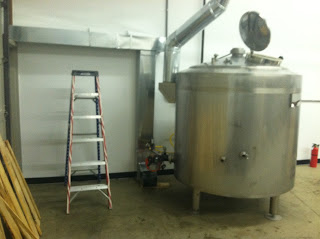
The kettle venting is almost done. It just needs the condensate stack (the material is backordered for a few more days). It's starting to look like an octopus since the building department made me put in a "make up air" duct. This is a fancy way of saying that I have to have a 6"x6" hole in the wall with no damper or cover that allows cold outside air to dump into my building and make my heating system run overtime all in the hopes that I won't somehow asphyxiate myself when the kettle burner is turned on (can you tell I'm not thrilled about this idea?). That's OK because they made me put another one on the furnace. I may as well just leave the door open all winter....Gotta love city building codes.....
You may have seen the Benny Hill-esque movie my brother did for the walk-in assembly. Well the part you didn't see was all of the caulking that had to be done on the seams. I think it was about ten tubes worth. Since there's no "windows" in there the fumes were pretty fun! But the real fun part has been the refrigeration system. When I bought the used walk-in I had a pretty good idea that the refrigeration system was junk. No big deal, it was still worth it. I know about a lot of things, but refrigeration is not one of them. Since I had previously worked with a company that sells new and refurbished refrigeration systems I figured I'd leave this to the experts so I had them run the load calculations and spec out a new system. A few days later it was here. My installer took one look at it and said there's no way it is big enough to cool my unit properly. A few phone calls later and I had 4 independent companies all telling me that the system needs to be bigger. So now we're stuck because the company that sold it to me still maintains it will work. The moral to this story, always ask more than one "expert" or learn how to do it yourself....
Fear not, I won't let this keep me down (although it's kinda making my ass hurt). We will get it squared away and get the right system hooked up. After that we are a few small wiring jobs away from final building inspections and then we can brew!
Everything for the most part is in place. There is still some final electrical hook-ups to be done but the plumbing is all inspected and ready to go. My mill is back from getting the legs extended and just needs a switch installed. The fermenters have all been re-insulated and the gaskets replaced. The glycol system will be plumbed in the next day or so and that end of the operation will be all wrapped up.
 |
| Newly modified mill. All the black frame is new. It used to only be about a foot and a half off the ground. |
 |
| Fermenter Insulation - Before and After |

You may have seen the Benny Hill-esque movie my brother did for the walk-in assembly. Well the part you didn't see was all of the caulking that had to be done on the seams. I think it was about ten tubes worth. Since there's no "windows" in there the fumes were pretty fun! But the real fun part has been the refrigeration system. When I bought the used walk-in I had a pretty good idea that the refrigeration system was junk. No big deal, it was still worth it. I know about a lot of things, but refrigeration is not one of them. Since I had previously worked with a company that sells new and refurbished refrigeration systems I figured I'd leave this to the experts so I had them run the load calculations and spec out a new system. A few days later it was here. My installer took one look at it and said there's no way it is big enough to cool my unit properly. A few phone calls later and I had 4 independent companies all telling me that the system needs to be bigger. So now we're stuck because the company that sold it to me still maintains it will work. The moral to this story, always ask more than one "expert" or learn how to do it yourself....
 |
| Looks nice, too bad it's too small... |
Sunday, February 12, 2012
Beerfest Wrap-Up
Hopefully everyone who wanted to go to the Cincy Beerfest got the chance to attend. It was a crazy scene but one that made me feel good. Good to see so many people interested in trying new beers. I believe the final count will be well above 10,000 people for the two day event. That's pretty good for a cold and slightly snowy weekend in this town. Sure there were some people there just to "get loaded" but from where I was located this seemed to be a manageably small percentage.
I'd like to thank everyone who stopped by to say hi and try the Octobersbest Brett Stout. I was pretty busy pouring beer most of the time so I didn't get as much time to talk to everyone as I would have liked and for that I apologize. I think the beer came out OK given the fact that it wasn't able to age on the Brett as long as the original homebrew version. A little bit has been kept back for the Great American Beer Festival Pro-Am in September which should give the beer plenty of time to let the Brett character develop further. This beer will definitely make a re-appearance as a Blank Slate beer in the future (probably even barrel aged). Big thanks go to the Cincinnati Malt Infusers and Rivertown Brewing Company for making that beer happen.
But now the fun is over. As good of a "distraction" from work as this weekend was, the truth is I have a LOT of things left to do. The walk-in has been put together but still needs some sealing and sorting out of the refrigeration. A couple things still need welded. The kettle venting needs to be finished. The state inspection is happening soon (yes the legal hurdles are not yet complete). There's still a lot of odds and ends to get settled. I'm probably going to have to go into "hiding" for the next month or so to get this thing done. So for as fun as Craft Beer Week and Beerfest were, it might be a little bit before I see anybody out and about again...
Unless something really good comes up!
I'd like to thank everyone who stopped by to say hi and try the Octobersbest Brett Stout. I was pretty busy pouring beer most of the time so I didn't get as much time to talk to everyone as I would have liked and for that I apologize. I think the beer came out OK given the fact that it wasn't able to age on the Brett as long as the original homebrew version. A little bit has been kept back for the Great American Beer Festival Pro-Am in September which should give the beer plenty of time to let the Brett character develop further. This beer will definitely make a re-appearance as a Blank Slate beer in the future (probably even barrel aged). Big thanks go to the Cincinnati Malt Infusers and Rivertown Brewing Company for making that beer happen.
But now the fun is over. As good of a "distraction" from work as this weekend was, the truth is I have a LOT of things left to do. The walk-in has been put together but still needs some sealing and sorting out of the refrigeration. A couple things still need welded. The kettle venting needs to be finished. The state inspection is happening soon (yes the legal hurdles are not yet complete). There's still a lot of odds and ends to get settled. I'm probably going to have to go into "hiding" for the next month or so to get this thing done. So for as fun as Craft Beer Week and Beerfest were, it might be a little bit before I see anybody out and about again...
Unless something really good comes up!
Sunday, February 5, 2012
Past the point of no return...
Ok. The point of no return was actually quite a while ago. Somewhere between signing the lease and signing for a loan you realize there's no going back. But I guess you could say I passed the emotional point of no return the other day. Last Thursday was my last official day at my "real job". Sure I'd only been working part time for the last 5 months, but there's something about having a steady paycheck that makes you feel like no matter what happens with the brewery everything will still be alright. I guess you'd call it the safety net effect.
I worked there for nine years and made a lot of good friends so it was a bit of an emotional day. After finally closing that chapter of my life I had a bit of a cathartic moment. No more dealing with empty-suit venture capitalist #*%hole owners. No more daily exposure to toxic chemicals. No more working for a company that puts a truck full of plastic in a landfill everyday. Of course this also means I'm technically unemployed. An even trade? No. I'm way ahead. Even though my security blanket is gone and there's a decent chance this whole endeavor could fall flat on its face, I wouldn't go back even if I could.
And that's what it's all about. Whether its making beer or selling lamps, it's about following a dream (and telling "the man" where he can stick it)...
P.S. Sorry for the sappy post.
I worked there for nine years and made a lot of good friends so it was a bit of an emotional day. After finally closing that chapter of my life I had a bit of a cathartic moment. No more dealing with empty-suit venture capitalist #*%hole owners. No more daily exposure to toxic chemicals. No more working for a company that puts a truck full of plastic in a landfill everyday. Of course this also means I'm technically unemployed. An even trade? No. I'm way ahead. Even though my security blanket is gone and there's a decent chance this whole endeavor could fall flat on its face, I wouldn't go back even if I could.
And that's what it's all about. Whether its making beer or selling lamps, it's about following a dream (and telling "the man" where he can stick it)...
P.S. Sorry for the sappy post.
Thursday, January 26, 2012
Headed for a Crash?
It's time for another non-construction-related post. As I have mentioned briefly before there are a lot of new breweries in various stages of opening in Cincinnati these days. While I firmly believe we are overdue to catch up with everyone else in the craft beer renaissance that is occurring all over the country, the pessimist in me sometimes wonders how many breweries we can actually sustain in this area. As I said before, there is definitely room for more breweries in this town, but how many? Two? Five? Ten? Of course this is a hypothetical question and I'm not asking it to stir any great debate, but some comments I read recently made me start thinking about this issue a little more deeply.
A few days ago on the Ohio Beer Blog Rick Armon interviewed Fred Karm of Hoppin' Frog Brewery in Akron. If you haven't read the Ohio Beer Blog, its a great resource for keeping up with the comings and goings of Ohio's breweries. Rick Armon writes for the Akron Beacon Journal and also wrote the Ohio Breweries book last year. One of his recurring features is "Five Questions With..." where he asks an Ohio brewer a set of questions about their favorite beer etc. The most recent installment featuring Fred Karm contained an interesting answer to the question "What advice would you give to someone who's interested in opening a brewery?" Here is his response (entire interview here):
"These days it seems everybody wants to start a brewery. It is understandable. I’d say DON’T DO IT — IT’S TOO RISKY, and oh, yeah, not to mention it’s really hard work. Sure, everybody wants to start a brewery these days, but I’ve seen this before. Reminds me of the American craft beer boom-and-bust of the late 1990s. These lessons of the recent past can teach us that the availability of craft beer grew way too fast compared to the customers. It appears that is the case again, with American craft beer sales being so predictable — they have been increasing at steady rate of about 11 percent over the last eight years. That rate of growth has been matched in the last decade with many existing breweries increasing their production. But in the last year many new American breweries have started up, and along with the growth of existing breweries, production recently has grown faster than the market can bear. And a lot more are already registering for 2012. That is too fast of a growth for the customer base. Back in the late 1990s, many newer breweries that weren’t as ingrained into the fiber of the community found themselves unable to make enough sales to stay in business. It is possible that this will happen again, as history does tend to repeat itself."
This response struck me as interesting. Usually this question is answered with upbeat statements like "keep at it, be true to yourself, etc" Fred Karm's candid response "don't do it" gave me pause. I've never met Mr. Karm, but I admire his brewery and his honest response to this question. He seems to have the data to back up his statements too. As someone who was also present during the first boom/bust I have to say that I agree we must be careful not to let history repeat itself. There were over a half dozen brewpub-type establishments in and around Cincinnati in the late nineties. A few years later Rock Bottom was the only one left. It's been 10 years and we're just now approaching the same level of brewing establishments we had back then. But how many more can we handle?
One place where I do disagree with Mr. Karm is in the interpretation of those growth numbers. While the growth rate may not be keeping pace with the expansion in output nationwide, there are definitely areas where this imbalance is much greater than here in Cincinnati. Maybe it's because we are always "late to the party" in this part of the country but I firmly believe local trends towards craft beer are on the upswing here at a pace that can definitely sustain a few more players in the market. According to the Craft Brewers Association Ohio ranks 32nd in breweries per capita but ranks 7th in population. By contrast Colorado is 22nd in population and 4th in breweries per capita. I think that means there is still room for improvement!
So, what's the answer? Beats me. I don't think we'll ever know where the "brewery saturation point" is in this town until we hit it (if we hit it at all). Until then (if it ever comes) it's going to be fun helping to build a wonderful community of small breweries here in Cincinnati.....
A few days ago on the Ohio Beer Blog Rick Armon interviewed Fred Karm of Hoppin' Frog Brewery in Akron. If you haven't read the Ohio Beer Blog, its a great resource for keeping up with the comings and goings of Ohio's breweries. Rick Armon writes for the Akron Beacon Journal and also wrote the Ohio Breweries book last year. One of his recurring features is "Five Questions With..." where he asks an Ohio brewer a set of questions about their favorite beer etc. The most recent installment featuring Fred Karm contained an interesting answer to the question "What advice would you give to someone who's interested in opening a brewery?" Here is his response (entire interview here):
"These days it seems everybody wants to start a brewery. It is understandable. I’d say DON’T DO IT — IT’S TOO RISKY, and oh, yeah, not to mention it’s really hard work. Sure, everybody wants to start a brewery these days, but I’ve seen this before. Reminds me of the American craft beer boom-and-bust of the late 1990s. These lessons of the recent past can teach us that the availability of craft beer grew way too fast compared to the customers. It appears that is the case again, with American craft beer sales being so predictable — they have been increasing at steady rate of about 11 percent over the last eight years. That rate of growth has been matched in the last decade with many existing breweries increasing their production. But in the last year many new American breweries have started up, and along with the growth of existing breweries, production recently has grown faster than the market can bear. And a lot more are already registering for 2012. That is too fast of a growth for the customer base. Back in the late 1990s, many newer breweries that weren’t as ingrained into the fiber of the community found themselves unable to make enough sales to stay in business. It is possible that this will happen again, as history does tend to repeat itself."
This response struck me as interesting. Usually this question is answered with upbeat statements like "keep at it, be true to yourself, etc" Fred Karm's candid response "don't do it" gave me pause. I've never met Mr. Karm, but I admire his brewery and his honest response to this question. He seems to have the data to back up his statements too. As someone who was also present during the first boom/bust I have to say that I agree we must be careful not to let history repeat itself. There were over a half dozen brewpub-type establishments in and around Cincinnati in the late nineties. A few years later Rock Bottom was the only one left. It's been 10 years and we're just now approaching the same level of brewing establishments we had back then. But how many more can we handle?
One place where I do disagree with Mr. Karm is in the interpretation of those growth numbers. While the growth rate may not be keeping pace with the expansion in output nationwide, there are definitely areas where this imbalance is much greater than here in Cincinnati. Maybe it's because we are always "late to the party" in this part of the country but I firmly believe local trends towards craft beer are on the upswing here at a pace that can definitely sustain a few more players in the market. According to the Craft Brewers Association Ohio ranks 32nd in breweries per capita but ranks 7th in population. By contrast Colorado is 22nd in population and 4th in breweries per capita. I think that means there is still room for improvement!
So, what's the answer? Beats me. I don't think we'll ever know where the "brewery saturation point" is in this town until we hit it (if we hit it at all). Until then (if it ever comes) it's going to be fun helping to build a wonderful community of small breweries here in Cincinnati.....
Monday, January 23, 2012
Moving Day!
Building construction is 98% of the way done. The floor is sealed. Nothing left to do but move in. Man, I thought this day would never come. And it almost didn't. It's just my luck to pick the morning after an ice storm to rent a 24' box truck to move all of my big equipment from it's undisclosed storage location about 30 miles away from the brewery.
In retrospect, it probably would have been a good idea to postpone since there was only one treated lane on I-71 and it wasn't treated very well. But plans had been made, the truck was already rented, and help had been arranged so there was no turning back. It's fun driving a big truck, but not so much on ice. After quite a bit of finagling we managed to get the truck there in one piece. It was colder than a "cold activated" Coors Light which made things all the more fun but we got it all done (except for a few small straglers that wouldn't fit in the truck. (Yes we filled a 24' truck and still didn't get it all in).
So on one hand I'm ecstatic that everything is finally here. On the other hand, now all I see is lots more work. Since most all of my equipment is used it means that very little is ready to "plug and play". Most everything needs some amount of work done to it. Whether its as simple as just needing a good cleaning or as complicated as needing some welding, EVERYTHING needs something. So as much time as I've spent constructing the space, I can't rest on those laurels as there is now just about as much work to do to get all the vessels ready to brew. Luckily this work is a little more fun than hanging drywall....
In retrospect, it probably would have been a good idea to postpone since there was only one treated lane on I-71 and it wasn't treated very well. But plans had been made, the truck was already rented, and help had been arranged so there was no turning back. It's fun driving a big truck, but not so much on ice. After quite a bit of finagling we managed to get the truck there in one piece. It was colder than a "cold activated" Coors Light which made things all the more fun but we got it all done (except for a few small straglers that wouldn't fit in the truck. (Yes we filled a 24' truck and still didn't get it all in).
 |
| Have brewery, will travel. |
 |
| It's starting to get crowded in here. |
Subscribe to:
Posts (Atom)